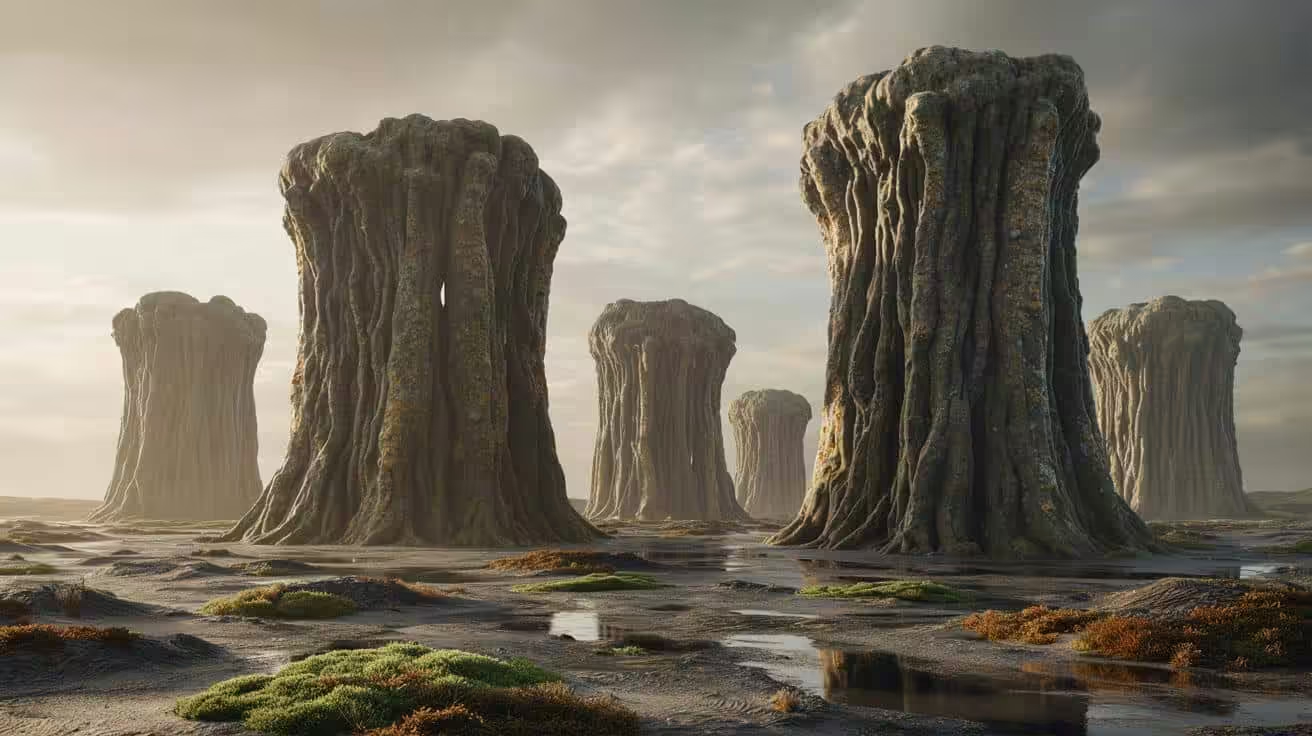
Imagine a world without trees – a planet where the tallest life forms were not towering oaks and redwoods, but mysterious, alien-like giants that dwarfed even the mightiest of modern flora. This is the awe-inspiring story of Prototaxites, a vanished form of life that ruled the Earth long before the first trees emerged.
These colossal pillars, standing taller than a two-storey house, were once the dominant lifeforms on our planet, predating the rise of forests by millions of years. But what were they exactly? Were they plants, fungi, or something else entirely? The answers to these questions have profound implications for our understanding of the early Earth and the evolution of life.
Reconstructing a Lost Ecosystem
Piecing together the story of Prototaxites is no easy task, as these enigmatic giants left behind few direct clues about their true nature. Fossilized specimens provide tantalizing glimpses, but deciphering their evolutionary relationships and ecological roles requires a deep dive into the geologic record and creative paleontological sleuthing.

What we do know is that Prototaxites thrived during the Devonian period, often referred to as the “Age of Fishes” due to the abundance of marine life at the time. Yet these towering organisms were not aquatic creatures, but rather an integral part of the first primitive terrestrial ecosystems that were slowly taking shape on land.
By studying the sedimentary rocks and fossilized remains associated with Prototaxites, researchers have been able to reconstruct a vivid picture of the ancient world in which they lived. It was a landscape devoid of trees, but teeming with a diverse array of other organisms, from primitive plants and fungi to a burgeoning array of arthropods and early tetrapods.
A Mysterious Form of Life
The true identity of Prototaxites has long been a source of scientific debate and speculation. For decades, they were classified as an early type of tree, but further analysis has revealed that they were not plants at all. Instead, these colossal pillars appear to have been a form of life unlike anything we see on Earth today.

Some researchers have suggested that Prototaxites were actually a giant species of fungus, while others have proposed that they were a unique type of organism that combined characteristics of both plants and fungi. The evidence points to Prototaxites being a complex, multi-celled lifeform that thrived in the Devonian’s nutrient-rich, low-oxygen environment.
Whatever their exact taxonomic classification, Prototaxites were undoubtedly a dominant force in the early terrestrial ecosystems, playing a crucial role in the cycling of nutrients and the establishment of the first primitive soils. Their towering presence likely had a profound impact on the development of the first land-based ecosystems, paving the way for the eventual rise of forests.
Why a Mysterious Fossil Matters Today
At first glance, the story of Prototaxites might seem like little more than a fascinating footnote in the history of life on Earth. But the lessons we can learn from these enigmatic giants have relevance and importance for the world we live in today.

By understanding the factors that allowed Prototaxites to thrive and dominate their ancient environment, we can gain valuable insights into the resilience and adaptability of life in the face of dramatic environmental changes. As the planet grapples with the ongoing effects of climate change, the study of these prehistoric giants may hold clues about how life on Earth can adapt and evolve in the face of adversity.
Moreover, the mystery surrounding the true nature of Prototaxites serves as a reminder of the limits of our scientific knowledge and the need for continued exploration and discovery. Even in an age of advanced technology and vast scientific resources, there are still secrets waiting to be uncovered about the history of life on our planet.
Imagining Prototaxites in Action
Visualizing the world of Prototaxites can be a challenging task, as these towering giants bear little resemblance to any living organisms we know today. But by piecing together the available evidence, we can begin to imagine the awe-inspiring sight of these colossal pillars dominating the early terrestrial landscapes.

Picture a Devonian landscape devoid of trees, where the tallest plants reach only a few feet in height. Towering above this verdant carpet, the massive trunks of Prototaxites rise like sentinels, their surfaces covered in a intricate pattern of grooves and ridges. Atop these towering columns, a crown of branch-like structures extends outward, perhaps capturing sunlight or releasing spores into the air.
Surrounding these giants, a diverse array of primitive plants, fungi, and early animals scurry and crawl, taking advantage of the resources and habitats created by the Prototaxites. The air is thick with the scent of decaying organic matter, as the colossal pillars act as conduits for the cycling of nutrients and the establishment of the first primitive soils.
A Vanished Form of Life
Ultimately, the fate of Prototaxites remains shrouded in mystery. What happened to these towering giants, and why did they eventually disappear from the face of the Earth? The answers to these questions may hold the key to understanding the complex web of evolutionary and environmental forces that have shaped the history of life on our planet.

One thing is certain: the story of Prototaxites serves as a powerful reminder of the incredible diversity and resilience of life on Earth. Even in the face of dramatic change and upheaval, new forms of life can emerge and thrive, only to vanish and be replaced by something entirely new.
As we continue to explore and unravel the secrets of the past, the tale of Prototaxites stands as a testament to the enduring wonder and mystery of the natural world. Who knows what other incredible lifeforms may be waiting to be discovered, hidden in the ancient rocks and sediments of our planet?
| Key Facts about Prototaxites | Dimensions and Appearance |
|---|---|
|
|
“Prototaxites represent a completely different type of organism that we have no modern equivalent for. They were a dominant life form that thrived in an environment very different from the one we know today.”
– Dr. Patricia Gensel, Paleobotanist at the University of North Carolina

| Comparisons to Modern Life Forms | Possible Ecological Roles |
|---|---|
|
|
“Prototaxites were a dominant feature of the early terrestrial landscape, but their exact role and relationships within those ecosystems are still not fully understood. Unraveling the mystery of these giant organisms is crucial for piecing together the story of life’s transition to land.”
– Dr. Emily Rayfield, Paleontologist at the University of Bristol

The story of Prototaxites reminds us that even the most dominant and seemingly permanent lifeforms can vanish, replaced by something entirely new. As we continue to explore the rich tapestry of life’s history on Earth, the lessons of these ancient giants may prove invaluable in navigating the challenges of the future.
What was Prototaxites?
Prototaxites was a mysterious, giant lifeform that dominated the early terrestrial ecosystems of the Devonian period, predating the rise of forests. Its exact taxonomic classification is still debated, but it appears to have been a unique form of life combining characteristics of both plants and fungi.
How tall were Prototaxites?
Prototaxites could grow up to 8 meters (26 feet) in height, with a trunk diameter of up to 1 meter (3.3 feet). They were the tallest organisms on the planet at the time, dwarfing the primitive plants and fungi that surrounded them.

Where and when did Prototaxites live?
Prototaxites thrived during the Devonian period, around 420-360 million years ago. They were a dominant feature of the first terrestrial ecosystems that were slowly taking shape on land, playing a crucial role in the development of those early environments.
Why did Prototaxites eventually disappear?
The reasons for the disappearance of Prototaxites from the fossil record are still not fully understood. It’s possible that they were outcompeted or displaced by the rise of more modern plant and fungal life forms, or that they were unable to adapt to significant environmental changes that occurred towards the end of the Devonian period.
What can we learn from Prototaxites today?
The study of Prototaxites provides valuable insights into the resilience and adaptability of life on Earth, as well as the limits of our scientific knowledge. Understanding the factors that allowed these enigmatic giants to thrive may hold clues about how life can adapt to dramatic environmental changes, which is particularly relevant in the face of modern-day challenges like climate change.
How do Prototaxites compare to modern life forms?
Prototaxites were a completely unique form of life, with no direct modern analogues. While they may have shared some characteristics with primitive plants and fungi, they appear to have been a distinct type of organism that combined features of both. This makes them challenging to classify and understand, but also highlights the incredible diversity of life that has existed on our planet throughout its history.
What were the ecological roles of Prototaxites?
Prototaxites likely played a crucial role in the early terrestrial ecosystems, acting as conduits for nutrient cycling and soil formation. They may have been a major producer of biomass, converting sunlight and atmospheric gases into organic matter that supported a diverse array of primitive plants, animals, and fungi. Prototaxites may have also had symbiotic relationships with other organisms, such as early land plants.
How do scientists study and reconstruct Prototaxites?
Studying Prototaxites requires a combination of paleontological analysis of fossilized specimens, as well as careful examination of the geological and sedimentary context in which they are found. By piecing together the available evidence, researchers can begin to reconstruct the ancient environments in which Prototaxites thrived and their likely ecological roles and evolutionary relationships.



